
On 2 September the Ministry of Education moved all government and private institutions under its purview, and under the Ministry of Religious Affairs, to home-based learning for 2 and 3 September. The trigger was the Pollutant Standards Index reading taken at 4.00pm on Tuesday 1 September, which showed air quality at a very unhealthy level.
The day after that, on 3 September, SHENA issued a Workplace Safety and Health Notice covering hazy conditions. If you employ people who work outdoors, or in buildings that are not sealed, it applies to you.
Where Things Stand Now
The home-based learning order covered 2 and 3 September only. The haze has not kept to a timetable. As of 21 September, Brunei’s readings have risen and fallen several times:
- 1 September, 4.00pm — Brunei-Muara 215 and Belait 211, very unhealthy; Tutong 168 and Temburong 164, unhealthy
- 3 September — Brunei-Muara 116 and Belait 107, still unhealthy
- 7 September — Belait back up to 152 by the afternoon
- 15 September — all four districts good, between 20 and 32, after rain
- 19 and 20 September — moderate across the country, with Belait highest at around 90
That is the pattern to plan for: a spike, a clear day or two, then another spike. Trigger points decided once and used every time will serve you better than a fresh debate each time the sky turns grey.
Where the Haze Is Coming From
This is transboundary haze. Satellite imagery from the ASEAN Specialised Meteorological Centre detected 514 hotspots across Borneo on 27 August, 1,734 on 28 August and 1,180 on 29 August. Smoke from those fires is carried to us on the wind, which is why conditions can change within a day and why they are outside anyone here controlling them.
The ASEAN Specialised Meteorological Centre raised its haze alert for the southern ASEAN region to Level 3, the highest of its three levels, on 27 August. The fires have continued since, in Kalimantan and in Sumatra.
We are not the only ones affected. In Sarawak, Serian recorded an Air Pollutant Index of 521 on 4 September and was declared an air-quality emergency until 7 September. Hundreds of schools across the state closed from 7 to 11 September, and on 21 September schools in Kanowit and Lubok Antu were ordered to close again. In Singapore, the 24-hour PSI reached 154 in the central region on the morning of 15 September, the first time since 2019 that all five regions were in the unhealthy range.
What Happens Next
Nobody is forecasting a quick end. The ASEAN Specialised Meteorological Centre expects the southwest monsoon to last into early October, followed by the inter-monsoon period and more showers, but it also expects below-normal rainfall across most of the southern ASEAN region. The northeast monsoon, with its heavier rain, does not normally arrive until late November or December.
The background is a strong El Niño alongside a positive Indian Ocean Dipole, the same combination behind the severe haze of 1997 and 2015. Indonesian officials have warned that the fires could continue into October or early November. Rain will bring clear days, as it did in mid-September. Plan on the assumption that the haze will be back.
What the Readings Mean
JASTRe publishes the PSI for Brunei-Muara, Tutong, Belait and Temburong. The bands are:
- 0 to 50 — Good
- 51 to 100 — Moderate
- 101 to 200 — Unhealthy
- Above 200 — Very Unhealthy to Hazardous
Even in the moderate band, between 51 and 100, minor effects such as coughing, eye irritation and a runny nose are expected. That matters because moderate sounds harmless and is not, particularly for someone doing heavy work for eight hours in it.
Check the reading before each shift rather than once a day. Readings are published by the Department of Environment, Parks and Recreation at env.gov.bn and on its Instagram account, @jastre.bn.
Since 1 September, JASTRe has also published PM2.5 readings alongside the PSI. PM2.5 is the fine particle fraction that reaches deepest into the lungs, and it is what a particulate respirator is designed to stop. Advisories are still given in PSI, so that remains the number to act on.
What SHENA Requires
Notice 2026/WSHN/04, Workplace Safety and Health Precautions During Hazy Conditions, was issued on 3 September 2026. It applies to principals, employers, occupiers, self-employed persons and persons at work.
As of 21 September it is still SHENA’s current notice on haze; nothing has replaced it.
Its central point is that where work results in significant exposure to haze, this should be recognised as an occupational health and safety hazard and managed through your normal risk management framework. It is not a separate regime; it is the risk assessment you should already have.
Two duties are cited directly. Section 12(3)(a) of the Workplace Safety and Health Act, Chapter 277 requires employers, so far as is reasonably practicable, to take the necessary measures to ensure the safety and health of persons at work, including providing and maintaining a work environment that is safe and without risk to health. Regulations 3 and 4 of the WSH (Risk Management) Regulations require a risk assessment, and that foreseeable risks are eliminated or, where that is not reasonably practicable, controlled.
There is still no PSI figure at which work must stop, and that is deliberate. SHENA asks for a risk-based judgement rather than a number: as readings rise or advisories indicate heightened risk, workplaces are expected to apply progressively more stringent precautions, weighed against the nature of the work, how long people are exposed, the environment, and the health of the people doing it.
So the decision comes back to your risk assessment. Decide your own trigger points before you need them, and record what you decided and why.
Who Is Most at Risk on Your Site
The Ministry of Health advises that people with asthma, lung and heart conditions, pregnant women, children, the elderly and those with dust allergies reduce outdoor physical activity.
At work, add one more group: anyone doing sustained heavy exertion. Hard physical work means breathing more air, more deeply, through the mouth rather than the nose. The same air outdoors is a larger dose for a scaffolder than for someone walking to a car.
You do not need anyone’s medical history to act sensibly. Tell people what the reading is, tell them what to do if they feel unwell, and make it easy to say so without a fuss.
Setting Your Trigger Points
SHENA leaves the numbers to you. If you want a starting point, two neighbours publish graded guidance: Malaysia’s Department of Occupational Safety and Health, which works from Malaysia’s Air Pollutant Index (its bands use the same numbers as Brunei’s PSI), and Singapore’s Ministry of Manpower. Neither applies here, and both use finer bands than this, but drawing on the two gives a simple version you can adapt in your own risk assessment:
- Moderate, 51 to 100 — work as normal, share the reading, and keep an eye on the people most at risk. Give heavy outdoor work more breaks.
- Unhealthy, 101 to 200 — cut prolonged or strenuous outdoor work, move people at higher risk indoors, and make N95 respirators available to anyone working outside.
- Above 200 — stop strenuous outdoor work and move vulnerable workers indoors. Keep outdoor work to what is essential, with respirators and short rotations.
Singapore’s guidelines also ask employers to keep at least a week’s supply of N95 respirators and to fit-test the people who will wear them. With the outlook as it is, that is worth doing now rather than on the morning of the next spike.
What to Do
Reduce the exposure before reaching for masks. A mask is the last line, not the first.
- Move the work. Bring what can be done indoors, indoors. Postpone what can wait.
- Cut the exertion. Shorter stints, longer breaks, more people sharing heavy tasks.
- Use the cooler hours, provide rest breaks and keep drinking water available. Heat and haze together are harder than either alone, and SHENA points to its own heat stress guidance for this — 2025/NTI/07, 2023/WSHN/04 and 2024/IGN/01.
- Keep indoor air cleaner. Close external doors and windows, keep ventilation and air-conditioning maintained, and where practicable avoid drawing in unfiltered outside air. SHENA also suggests air purifiers fitted with HEPA filters where reasonably practicable.
- Watch visibility. Heavy haze cuts sight lines. Reversing vehicles, lifting operations and road work all get more dangerous before anyone coughs.
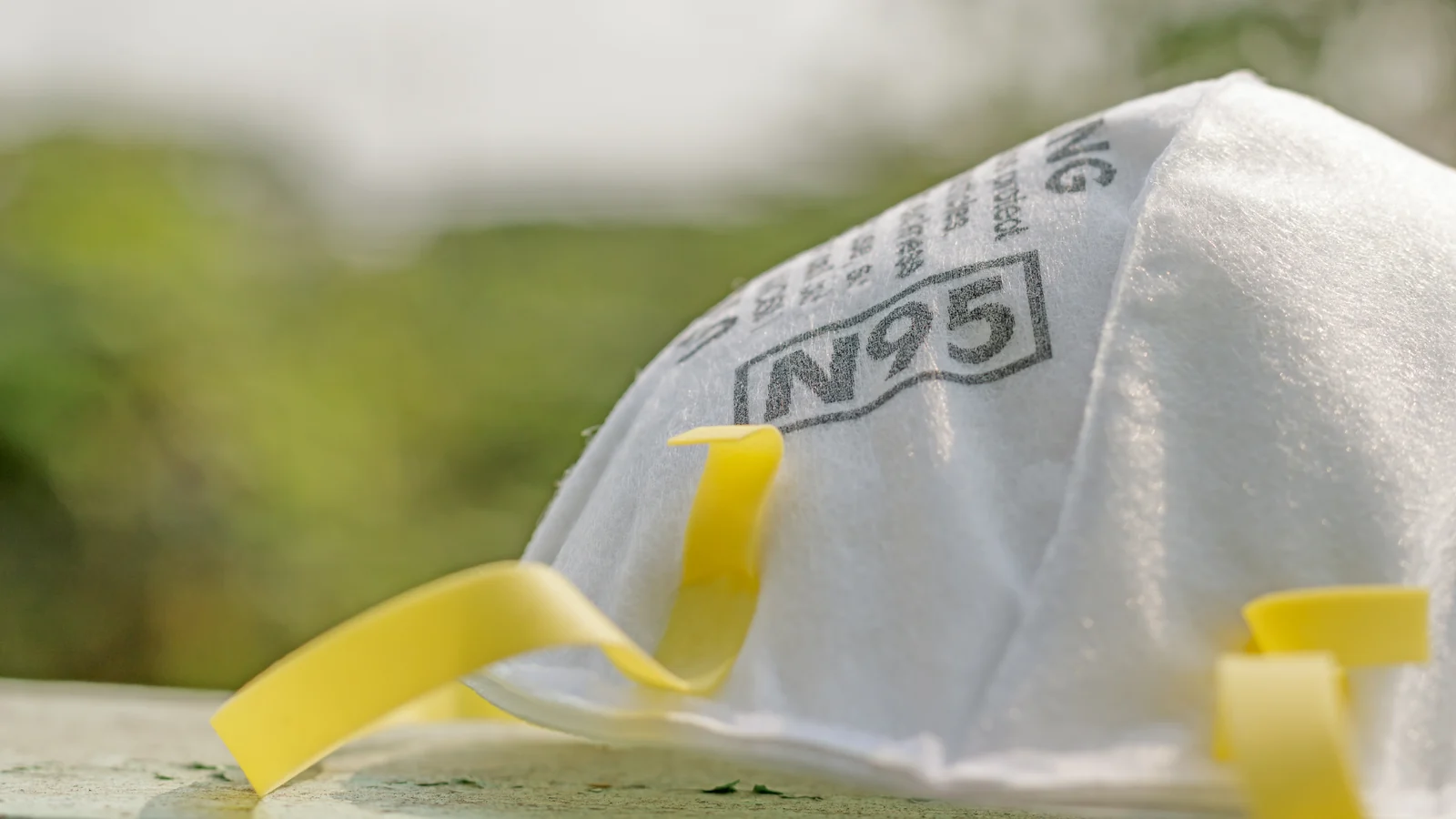
- If masks are needed, they must be particulate respirators such as N95. A surgical or cloth mask does not filter fine particles. A respirator only works if it seals, which means it will not work over a beard.
A Short Checklist
- Someone named checks the PSI before each shift
- Your own trigger points are written down, not decided in the moment
- Supervisors know they can stop or move work without asking twice
- Workers know the symptoms and know reporting them is expected
- Respirators, if used, are the right type and fit the person wearing them
- A week’s supply of N95 respirators is in stock before you need it
- Decisions are recorded, with the reading that prompted them
Conditions change quickly. What was moderate this morning may not be by the afternoon, so decide your triggers now, while nobody is under pressure.
Sources
- SHENA — Workplace Safety and Health Notice 2026/WSHN/04: Workplace Safety and Health Precautions During Hazy Conditions, 3 September 2026
- Ministry of Education, Brunei Darussalam — Implementation of Home-Based Learning (HBL) Following an Increase in the Pollutant Standards Index (PSI), 2 September 2026
- Department of Environment, Parks and Recreation (JASTRe) — env.gov.bn, and @jastre.bn
- ASEAN Specialised Meteorological Centre — Borneo hotspot counts, 27 to 29 August 2026
- Ministry of Health, Brunei Darussalam — public haze advisory
- Ministry of Development, Brunei Darussalam — haze situation press release, 4.00pm readings, 1 September 2026
- JASTRe readings as reported by Borneo Bulletin and Asia News Network — 3 September, 7 September, 15 September, 19 September and 20 September 2026
- ASEAN Specialised Meteorological Centre — Alert Level 3 for the southern ASEAN region, 27 August 2026, and seasonal outlook
- Sarawak — Serian API reading of 521, 4 September; school closures, 7 to 11 September; Kanowit and Lubok Antu closures, 21 September 2026
- National Environment Agency, Singapore — haze situation update, 15 September 2026, and Malay Mail’s report the same day
- TIME — Indonesian warnings on the fire season, 17 September 2026; World Resources Institute — El Niño and the Indian Ocean Dipole
- Department of Occupational Safety and Health, Malaysia — Guidelines for the Protection of Employees Against the Effects of Haze at Workplaces
- Ministry of Manpower, Singapore — Guidelines on Protecting Employees from Haze
Updated on 21 September 2026 with the readings since 3 September, the regional picture, the outlook and graded trigger points. Updated on 3 September 2026 to reflect SHENA Notice 2026/WSHN/04, Workplace Safety and Health Precautions During Hazy Conditions, issued the day after this was published. Originally published on 2 September 2026.